|
A Lawyer’s Guide to the New ‘Trump Accounts’: Features, Flaws, and Smart Strategies for Your Family
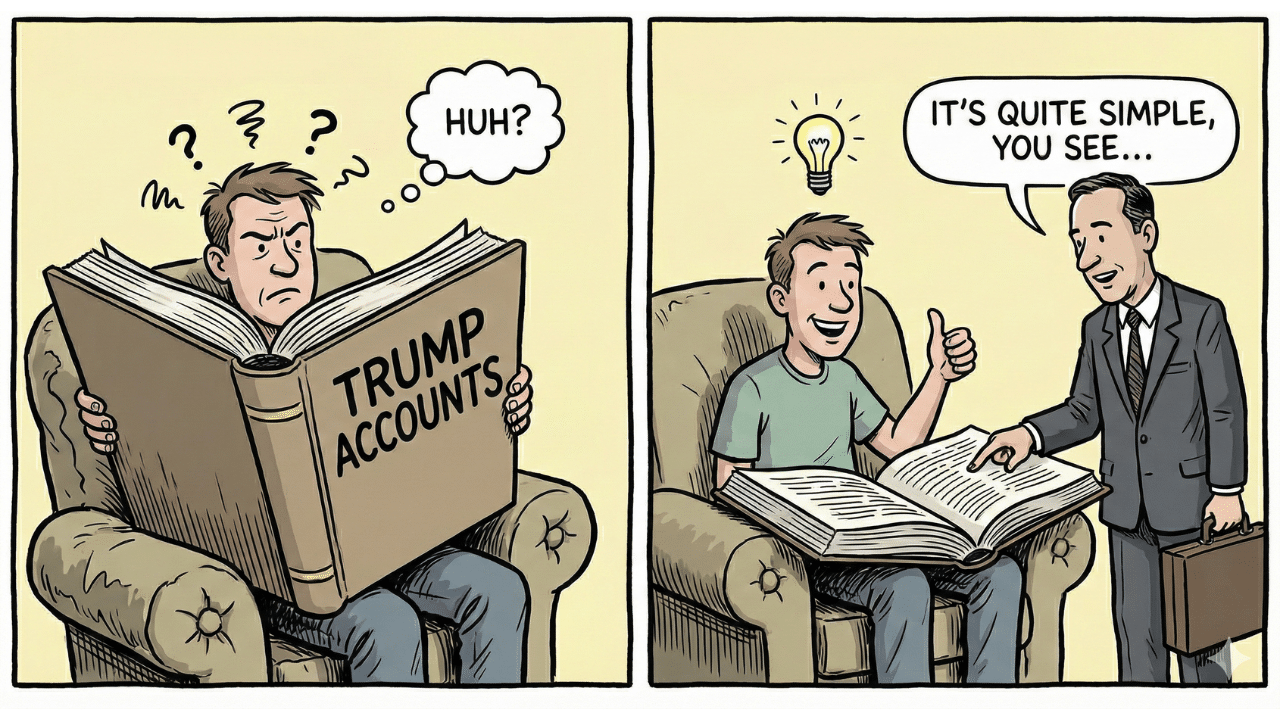
On July 4, 2025, the landscape of American tax and fiscal policy underwent a seismic shift with the signing of the One Big Beautiful Bill Act (OBBBA). This landmark legislation represents one of the most significant overhauls of the U.S. tax code in recent memory, making permanent many of the expiring provisions from the 2017 Tax Cuts and Jobs Act while simultaneously introducing a host of new tax deductions, spending priorities, and sweeping changes to federal benefit programs.
A headline provision of this massive bill is the creation of a new financial vehicle: the “Trump Account.” Marketed as a revolutionary tool to foster an “ownership society” and provide every American child with a financial head start from birth, these accounts have been hailed by proponents as a path to prosperity for a new generation. The name itself, directly tied to the sitting president, is a departure from the typically neutral monikers of financial instruments and signals its status as a signature policy initiative.
The purpose of this analysis is to provide a clear, legally-grounded examination of these new accounts, cutting through the political rhetoric to deliver an objective assessment. As a lawyer focused on estate planning, tax planning, business transactions, and other related matters, my goal is to equip YOUR family with the information YOU need to make sound financial decisions. This article will serve as a guide, explaining what Trump Accounts are, how their mechanics function under the law, their significant and often hidden flaws, and how families can strategically incorporate them—or choose not to—into their long-term financial planning.
It is impossible to analyze Trump Accounts in a vacuum. The OBBBA, projected to add trillions to the national debt, finances its tax cuts and new programs through a combination of increased borrowing and significant reductions in social spending. Specifically, the same law that creates this new savings vehicle imposes stricter eligibility criteria and funding restrictions on foundational support programs like Medicaid and the Supplemental Nutrition Assistance Program (SNAP). This context reveals a fundamental tension within the legislation: it offers a new, market-based savings tool while simultaneously retracting more direct forms of aid for the nation’s most vulnerable families. Understanding this broader legislative philosophy is critical to grasping the true nature and potential impact of the Trump Account program.
From a legal standpoint, a Trump Account is a new type of tax-deferred savings vehicle established for the benefit of a minor. Functionally, it operates as a “starter” Individual Retirement Account (IRA), with a unique set of rules governing its initial phase before it converts to a standard IRA later in the beneficiary’s life. The provisions establishing these accounts are set to take effect in 2026, with the first contributions permitted on or after July 4, 2026.
The most compelling and widely publicized feature of the program is the initial federal funding for a select cohort of children.
- The $1,000 “Seed Money”: The federal government will make a one-time, non-taxable contribution of $1,000 to an account established for each eligible child. This initial deposit is intended to “seed” the account and begin the process of wealth accumulation through market growth.
- Eligibility for the Pilot: This initial federal contribution is not universal. It is strictly limited to a “pilot” group of children who are U.S. citizens with a valid Social Security number and are born between January 1, 2025, and December 31, 2028. The citizenship status of the parents is not a determining factor; eligibility is based solely on the child’s status. Children born before or after this four-year window may still have Trump Accounts opened on their behalf but are not eligible to receive the $1,000 federal deposit.
- Enrollment Mechanism: For the eligible pilot cohort, enrollment is designed to be automatic, facilitated through the federal tax return system. While this appears efficient, it contains a significant structural flaw. A considerable number of low-income families earn below the minimum threshold required to file federal income tax returns. Consequently, the very mechanism intended to ensure automatic and universal inclusion for newborns will systematically miss many of the most economically vulnerable children the program is ostensibly designed to help. This suggests that from its inception, the program’s reach may be limited, favoring families already integrated into the formal financial system.
A critical, and perhaps defining, feature of the Trump Account is its mandatory conversion upon the beneficiary reaching adulthood. On January 1 of the year the child turns 18, the account legally and automatically converts into a traditional IRA. This is not a minor detail; it dictates the entire framework for taxation and withdrawals for the remainder of the account’s existence. From that date forward, the account is no longer a “Trump Account” in a legal sense but is subject to the complete set of rules, regulations, and tax implications that govern all traditional IRAs under the Internal Revenue Code.
The rules governing contributions to Trump Accounts are multifaceted, creating a complex, four-tiered system of funding sources. Understanding these distinct tiers is essential for any family considering using the account beyond the initial federal seed money.
The law defines four separate classes of potential contributors, each with unique limits and tax treatments.
- Federal Government: As detailed above, this is the one-time $1,000 seed deposit for the pilot cohort. This amount does not count toward the account’s annual contribution limit.
- Family and Individuals: Parents, grandparents, other relatives, or any individual may contribute to a child’s account. These contributions are made with after-tax dollars (meaning they are not tax-deductible). The total amount that can be contributed from all family and individual sources is capped at $5,000 per year, per child. This annual limit will be indexed for inflation beginning in 2028.
- Employers: The OBBBA allows a parent’s employer to contribute to their child’s Trump Account. This is positioned as a new employee benefit. However, any employer contribution counts against the same $5,000 annual limit applicable to family contributions. The primary advantage of this feature is its tax treatment: up to $2,500 of an employer’s annual contribution is excluded from the employee’s gross income. This makes it a tax-free benefit for the employee, akin to employer contributions for health insurance, and a deductible business expense for the employer.
- Governmental Entities and Non-Profits: State, local, or tribal governments, as well as qualified 501(c)(3) charitable organizations, are permitted to make contributions. These contributions must be made to a “qualified group” of beneficiaries, such as all children residing in a specific school district or county. Critically, these contributions are not subject to any dollar limit and do not count against the $5,000 annual cap. The funds are considered tax-free to the beneficiary until they are eventually withdrawn.
The employer contribution feature, while attractive on its face, may have unintended consequences for wealth inequality. Offering and administering this type of benefit requires a level of payroll and HR sophistication more common in large corporations than in small businesses. Since higher-wage, professional jobs are disproportionately concentrated in these larger firms, which already tend to offer more generous benefits packages, the children of higher-income families are more likely to receive these employer-funded contributions. This creates a scenario where a benefit designed to be universal is, in practice, distributed unevenly, potentially widening the financial gap between the children of high-wage and low-wage workers.
For clarity, the complex contribution rules are summarized in the table below.
| Contributor | Annual Limit | Counts Toward $5,000 Cap? | Tax Treatment of Contribution |
|---|---|---|---|
| Federal Government | $1,000 (one-time pilot) | No | N/A (Government funds) |
| Family/Individuals | $5,000 (combined) | Yes | After-tax (not deductible) |
| Employer | $5,000 (combined with family) | Yes | Tax-free to employee (up to $2,500); deductible for employer |
| States/Non-Profits | No Limit | No | Tax-free to beneficiary until withdrawn |
Unlike the broad investment flexibility offered by other savings vehicles like 529 plans or standard custodial brokerage accounts, the OBBBA imposes a highly restrictive and specific investment mandate on Trump Accounts during the beneficiary’s childhood.
- Strict Investment Mandate: The law requires that all funds in a Trump Account be invested in a “qualified mutual fund” or exchange-traded fund (ETF). This leaves no room for self-direction or alternative investment strategies.
- Index Fund Requirement: The definition of a “qualified” fund is narrow. The fund must be designed to track the performance of a broad-market U.S. equity index, with the S&P 500 being the primary example. The law explicitly prohibits the use of funds that track specific industries or sectors, such as technology, energy, or healthcare.
- Low-Cost Focus: To protect the account from being eroded by high fees, the legislation caps the annual fees and expenses of the qualified fund at 0.1% of the account balance. This effectively mandates the use of very low-cost, passively managed index funds.
- No Active Management: The combination of these rules means that active management is not an option. Families cannot pick individual stocks or bonds, invest in alternative assets, or use an actively managed mutual fund that seeks to outperform the market.
This rigid, passive investment strategy is a double-edged sword. On one hand, it protects families with little investment experience from making poor choices or paying excessive fees, ensuring a baseline of disciplined, market-based growth. On the other hand, it introduces a significant and often overlooked danger: sequence of returns risk. Standard financial planning for a time-bound goal, such as paying for college, involves gradually shifting a portfolio from higher-risk assets (like stocks) to more conservative assets (like bonds and cash) as the target date approaches. This de-risking strategy protects the accumulated capital from a sudden market downturn. 529 plans, for example, commonly offer “age-based” portfolios that perform this shift automatically.
The Trump Account structure makes this prudent strategy impossible. The account of a 17-year-old on the cusp of needing funds for college will have the same 100% U.S. stock allocation as the account of a newborn. This exposes the entire accumulated balance to full market volatility at the worst possible time. A major stock market correction in the year the beneficiary turns 18 could decimate the account’s value with no time for recovery, severely undermining its utility for the very purposes—education and homeownership—it is meant to support.
The rules governing access to the funds in a Trump Account are strict and directly tied to its legal transformation into a traditional IRA.
- The Age 18 Gate: The law is unequivocal: no withdrawals are permitted for any reason before January 1 of the calendar year in which the beneficiary turns 18. The only minor exceptions are for administrative purposes, such as performing a qualified rollover or correcting an excess contribution. This hard gate means the funds are completely inaccessible throughout childhood and adolescence.
- Post-18 Taxation: The Traditional IRA Framework: Once the account converts to a traditional IRA, the tax treatment of withdrawals is governed by standard IRA rules. This is a critical point of differentiation from other savings vehicles. Any portion of a withdrawal that consists of investment earnings, the initial $1,000 federal deposit, or contributions from employers or non-profits is considered pre-tax money. As such, it is taxed as ordinary income to the beneficiary in the year of the withdrawal. Only the portion of a withdrawal attributable to the family’s after-tax contributions (the “basis”) is returned tax-free.
- The 10% Early Withdrawal Penalty: In addition to income tax, if the beneficiary withdraws funds after turning 18 but before reaching age 59 ½, the taxable portion of the withdrawal is generally subject to an additional 10% penalty tax.
- Key Penalty Exceptions: The true flexibility of the account comes from the fact that it inherits the standard list of exceptions to the 10% early withdrawal penalty for IRAs. While the beneficiary must still pay ordinary income tax on the withdrawal, the 10% penalty is waived if the funds are used for certain qualified purposes, including:
- Higher Education Expenses: An unlimited amount can be withdrawn penalty-free to pay for qualified college tuition, fees, books, and other related expenses.
- First-Time Home Purchase: Up to a lifetime maximum of $10,000 can be withdrawn penalty-free to buy, build, or rebuild a first home.
- Other Exceptions: Other standard IRA exceptions, such as for total and permanent disability, certain unreimbursed medical expenses, or qualified birth or adoption expenses, also apply.
This tax structure creates a significant “tax drag” that makes Trump Accounts an inefficient vehicle for funding their primary stated goals when compared to existing alternatives. For example, if a student withdraws $20,000 from a 529 plan to pay for tuition, the entire amount is federally tax-free. If that same student withdraws $20,000 from a Trump Account for the same purpose, they avoid the 10% penalty, but the portion of the withdrawal representing earnings and government/employer contributions is fully taxable as income. If $15,000 of that withdrawal is taxable and the student is in the 12% federal tax bracket, they will owe $1,800 in taxes. The account, therefore, delivers less usable, after-tax money for the exact purpose it is marketed to support. It is a retirement account being repurposed for medium-term goals, and this structural mismatch results in significant tax friction.
Beyond the specific mechanics of contributions and withdrawals, a deeper legal and policy analysis of the OBBBA reveals several structural weaknesses in the Trump Account program that may limit its effectiveness and create unintended negative consequences.
- Lack of Centralized Structure: Unlike state-administered 529 plans, which leverage economies of scale, the Trump Account program as designed in the OBBBA lacks a centralized administrative body. This “open market” approach, where accounts are established with various private financial institutions, is likely to result in higher administrative fees that will erode investment returns over time. It also presents a significant logistical challenge for implementing a truly seamless and automatic enrollment system, as there is no central clearinghouse to manage the process.
- The Public Benefits “Trap”: In a critical oversight, the legislation fails to provide a statutory exemption for Trump Account assets in determining a family’s eligibility for means-tested federal benefit programs like Medicaid and SNAP. This creates a perilous “asset limit cliff.” A low-income family could diligently save in a Trump Account, only to find that once the balance crosses a certain threshold, they are disqualified from receiving essential healthcare or nutrition assistance. This forces the most vulnerable families to choose between saving for their child’s future and meeting their immediate needs—a direct policy contradiction.
- Ineffective Targeting for Inequality: The program’s design lacks meaningful progressive features. The $1,000 seed deposit is a flat amount for all eligible children, with no mechanism to provide larger initial contributions to children from lower-wealth households who would benefit most. Furthermore, as previously analyzed, ancillary benefits like the tax-advantaged employer contributions are more likely to be utilized by higher-income families. The cumulative effect is a program that may fail to meaningfully close the wealth gap and could, in some respects, even exacerbate it by providing more avenues of tax-advantaged savings to those who are already in a position to save.
- Unnecessary Complexity: The U.S. tax code is already a labyrinth of more than a dozen different tax-advantaged savings accounts—including 529 plans, Coverdell ESAs, Roth and traditional IRAs, 401(k)s, HSAs, and ABLE accounts—each with its own intricate set of rules. The introduction of yet another distinct account type adds a new layer of complexity for families to navigate and increases the administrative burden on the IRS. A simpler approach, such as enhancing an existing vehicle like the 529 plan or creating a truly streamlined Universal Savings Account, was bypassed in favor of creating a new, bespoke program.
When viewed in concert, these structural flaws paint a picture of a “policy mirage.” The Trump Account program appears to offer a universal, straightforward benefit, but its underlying legal structure is designed in a way that its positive impacts are likely to be limited, unevenly distributed, and, for the most vulnerable families, potentially offset by severe negative consequences.
For the vast majority of families, the most pressing practical question will be how this new account compares to the most popular existing child savings vehicle: the 529 plan. For those whose primary goal is saving for education, the analysis is clear: the 529 plan remains the superior instrument due to its vastly more favorable tax treatment.
The key differentiators are stark. 529 plans allow for much higher contribution limits, with many states permitting lifetime balances to exceed $500,000, compared to the Trump Account’s strict $5,000 annual cap. They offer a wide array of investment choices, including the critical age-based portfolios that de-risk as a child nears college age, a feature absent from Trump Accounts. Furthermore, many states provide a state income tax deduction or credit for contributions to their 529 plan, a benefit that does not apply to Trump Accounts. The OBBBA itself actually expanded the utility of 529 plans, allowing funds to be used for a wider range of K-12 expenses, apprenticeship programs, and even rollovers to a Roth IRA.
The most crucial distinction, however, remains the taxation of withdrawals. Qualified withdrawals from a 529 plan for education expenses are 100% free from federal income tax. Withdrawals from a Trump Account for the same purpose are subject to ordinary income tax. This fundamental difference in tax efficiency is the deciding factor for education savers.
The following table provides a direct, feature-by-feature comparison to aid in decision-making.
| Feature | Trump Account | 529 Plan | The Lawyer’s Verdict |
|---|---|---|---|
| Federal Seed Money | $1,000 for eligible children | None | Winner: Trump Account (for the free money) |
| Annual Contribution Limit | $5,000 (Family + Employer) | No federal limit; state limits are very high (e.g., $500k+) | Winner: 529 Plan |
| Tax on Contributions | After-tax (no federal deduction) | After-tax (but many states offer deductions/credits) | Winner: 529 Plan |
| Tax on Withdrawals (Qualified) | Taxed as ordinary income | 100% Tax-Free (Federal and often State) | Winner: 529 Plan (This is the most important distinction) |
| Investment Options | Highly restricted (US index funds only) | Wide variety of options, including age-based portfolios | Winner: 529 Plan |
| Use of Funds | Flexible (Education, Home, Retirement, etc. via IRA rules) | Primarily Education (K-12, College, Apprenticeships, Student Loans, Roth IRA rollover) | Draw (Depends on goal; 529 is better for education, Trump Acct is broader) |
Navigating this new legislation requires a clear and pragmatic strategy. Based on a thorough legal analysis of the OBBBA, the following steps represent a prudent course of action for most families.
- Take the Free Money. For any family with a child born within the pilot window (January 1, 2025, to December 31, 2028), the first step is unequivocal: open a Trump Account to secure the $1,000 federal seed deposit. There is no financial downside to accepting this initial government contribution, and it represents an immediate, risk-free return.
- Prioritize Your 529 Plan for Education Savings. Do not let the introduction of Trump Accounts derail a sound education savings strategy. The 529 plan should remain the primary, workhorse vehicle for all funds earmarked for educational expenses. Its superior tax advantages for this specific goal make it the most efficient way to save for K-12 tuition, college, or vocational training.
- View the Trump Account as a Supplemental Long-Term Savings Vehicle. The most accurate way to think about a Trump Account is not as an education fund, but as a child’s first retirement account. Given its conversion to a traditional IRA and its tax structure, its best use is for very long-term, tax-deferred growth that will be tapped decades in the future.
- Leverage the Employer Contribution. The employer match is one of the most powerful features of the Trump Account. If an employer offers to contribute, families should prioritize contributing at least enough to capture the full employer portion, especially the first $2,500 that is delivered as a tax-free benefit to the employee. This is one of the few scenarios where it may make sense to direct funds to a Trump Account before maxing out other vehicles.
- Be Acutely Aware of the Public Benefits Trap. For families who currently receive, or may foreseeably need to apply for, means-tested federal benefits like Medicaid, SNAP, or Supplemental Security Income (SSI), extreme caution is warranted. Before contributing any personal funds beyond the initial government seed money, it is imperative to consult with a financial advisor or a public benefits specialist to understand the specific asset limits in your state and how a growing Trump Account balance could impact eligibility.
- Consult a Professional. The interaction between these new accounts, existing savings plans, a family’s specific tax situation, and their overall estate and financial goals is inherently complex. This analysis provides general legal and financial information, but it is not a substitute for personalized advice from a qualified Certified Public Accountant (CPA), Certified Financial Planner (CFP®), or an attorney who can provide guidance tailored to individual circumstances.
The Trump Account represents a significant, if flawed, legislative experiment. The core concept—seeding an investment account for every child at birth to promote a culture of savings and provide a stake in the nation’s economic growth—is laudable and has roots in bipartisan policy proposals. However, the final version of the program as enacted in the OBBBA is hampered by a series of considerable design flaws.
The program’s restrictive investment mandate creates undue risk as beneficiaries approach adulthood, its tax structure is inefficient for its most prominently advertised goals of education and homeownership, and its implementation contains policy contradictions that may limit its reach and even cause harm to the low-income families it is intended to help.
For American families, the optimal path forward is a nuanced, hybrid strategy. The rational first step for all who are eligible is to open a Trump Account to capture the $1,000 of “free money” from the federal government. Beyond that, however, the 529 plan should remain the cornerstone of any education savings plan. The Trump Account is best treated as a secondary, supplemental vehicle—a child’s first IRA, to be used for long-term retirement savings, and to be funded further primarily when a valuable employer contribution is on the table.
While the OBBBA has introduced a new tool into the financial planning landscape, it is a tool with significant limitations. Families must approach it with a clear-eyed understanding of its specific purpose and its many shortcomings to navigate it safely and effectively.
The information provided in this article is for general informational and educational purposes only and is not intended to be, and should not be construed as, legal, tax, investment, or financial advice. The content is not specific to any individual or entity and does not take into account personal circumstances.
Reading this article does not create an attorney-client or any other professional relationship. The information presented here is not a substitute for obtaining tailored advice from a qualified professional. You should consult with your own independent legal, tax, and financial advisors before making any decisions based on the information contained herein.
The author and publisher have made reasonable efforts to ensure the accuracy and reliability of the information provided. However, we do not guarantee the accuracy, completeness, or timeliness of any information published, and we accept no liability for any errors or omissions in the material or for any loss or damage incurred from acting or refraining from acting as a result of this content. All investments carry risk, and past performance is not indicative of future results.
)
Contact Us
The attorney responsible for this site for compliance purposes is Ryan G. Reiffert.
Unless otherwise indicated, lawyers listed on this website are not certified by the Texas Board of Legal Specialization.
Copyright © Law Offices of Ryan Reiffert, PLLC. All Rights Reserved.