Posted in Political Landscape
|
The Supreme Court Appears Poised to Strike Down The Trump Tariffs
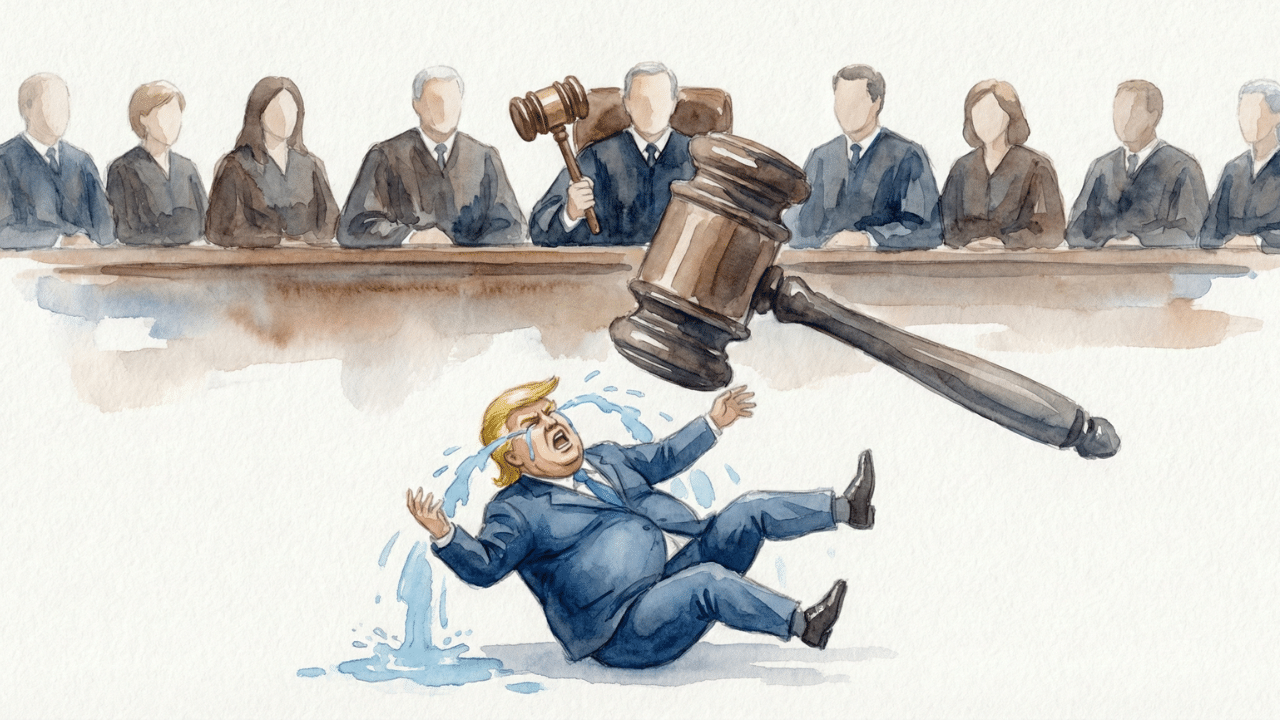
The November 5, 2025, oral arguments in the consolidated cases of Learning Resources, Inc. v. Trump and Trump v. V.O.S. Selections represent one of the most significant separation-of-powers showdowns in modern history. Hailed by some legal scholars as the most important case on presidential power since Youngstown Sheet & Tube Co. v. Sawyer—the landmark 1952 decision that blocked President Truman from seizing steel mills—this dispute tests the very boundaries of congressional and executive authority. At stake is the legality of the Trump administration’s “signature economic policy”: a sweeping, unilateral tariff regime conjured not from any specific trade law, but from a 1970s emergency statute. The President himself has underscored the stakes, in typically binary terms, calling the case “one of the most important in the History of the Country”.
The administration’s core legal claim, presented by Solicitor General D. John Sauer, is as simple as it is audacious. The government contends that the International Emergency Economic Powers Act (IEEPA), a 1977 law, grants the president virtually unlimited authority to impose tariffs by executive fiat. The entire argument rests on a “sweeping and unqualified” reading of Section 1702 of the law. This provision allows the president, after declaring a national emergency, to “investigate, block… regulate, direct and compel, nullify, void, prevent or prohibit, any… importation”. According to the Solicitor General, the simple verb “regulate” implicitly contains within it the entirety of Congress’s Article I power to tax and tariff, which he described as a “core application” of the power to “regulate importation”.
This interpretation is not merely a textual stretch; it is a profound historical perversion of IEEPA’s entire purpose. Both IEEPA and the related National Emergencies Act (NEA) were passed in the 1970s as a direct, post-Watergate rebuke to executive overreach. They were explicitly designed by Congress to rein in and limit the very kind of unbound presidential emergency power the Trump administration now claims. The administration is, in effect, attempting to weaponize a statute that was forged as a shield for Congress and turn it into an unlimited sword for the executive.
The administration’s convenient theory is that Congress, while simultaneously passing specific trade laws like the Trade Act of 1974 with “carefully crafted limitations”—such as a 15% cap and a 150-day time limit on certain presidential tariffs—also accidentally gave the president an unlimited and permanent tariff power in a general emergency law that “does not even mention tariffs”. This argument, that Congress hid the elephant of its core constitutional taxing power in the mousehole of a single statutory verb, was met with deep and warranted skepticism. The administration’s attempt to bolster its case by citing Dames & Moore v. Regan was equally unpersuasive, as Chief Justice John Roberts himself pointed out from the bench that the Dames & Moore case “did not concern tariffs” and its holding was explicitly narrow.
The Constitutional Core: Imposition of Taxes on Americans
The fundamental flaw in the administration’s case was exposed almost immediately, not by the Court’s liberal wing, but by Chief Justice John Roberts. In a series of piercing questions, Roberts cut through the government’s attempts to frame the issue as one of foreign affairs, where the president enjoys broad Article II authority. Roberts masterfully reframed the debate, stating that while the duties deal with foreign powers, “the vehicle is imposition of taxes on Americans, and that has always been a core power of Congress”. This single observation is the analytical key to the entire case. By defining the tariffs as taxes on Americans, Roberts grounded the dispute firmly in Article I of the Constitution, where Congress’s power over the purse is plenary. Justice Sonia Sotomayor, echoing this sentiment, was even more blunt in her rejection of the government’s legal fiction. She directly challenged Solicitor General Sauer’s claim that the tariffs were merely “regulatory.” “It’s a congressional power, not a presidential power, to tax,” Sotomayor declared. “And you want to say tariffs are not taxes, but that’s exactly what they are. They’re generating money from American citizens, revenue”. The justices are correct to define these levies as taxes, and the “vast economic and political significance” of this tax regime is not a theoretical abstraction. It is a measurable, multi-billion-dollar burden on the American economy, a fact that provides the crucial evidentiary foundation for applying the Major Questions Doctrine. The economic data demonstrates conclusively that these are not minor “regulations” but massive, distortionary taxes. Analysis from the Tax Foundation estimates that the IEEPA tariffs alone will reduce America’s long-run GDP by 0.4% and eliminate the equivalent of 428,000 full-time jobs. For the average American household, the total cost of the administration’s blunderbuss tariffs (including the IEEPA measures) amounts to a staggering tax increase of $1,600 in 2026. The Brookings Institution corroborates this, labeling tariffs as a “damaging and inefficient way to raise funds” that “will hurt consumers” and “reduce economic growth”. One estimate places the total cost to economic growth from the current tariff level at approximately $800 billion. This data, summarized in the table below, provides the factual proof that these tariffs are precisely what Chief Justice Roberts called them: a “major authority” and a “tax on Americans”.Economic Impact of the Administration’s Tariff Regime
| Economic Metric | Finding |
|---|---|
| Cost to US Households | $1,600 average tax increase per household in 2026. |
| Impact on US GDP | -0.4% reduction in long-run GDP (from IEEPA tariffs). |
| Total Economic Cost | $800 Billion (from reduced growth). |
| Impact on US Jobs | -428,000 full-time equivalent jobs lost. |
| Characterization | “Damaging and inefficient way to raise funds”; “will hurt consumers.” |
The Major Questions Doctrine as the Constitutional Off-Ramp
Given the colossal economic stakes and the paper-thin statutory text, the Court’s conservative majority appears poised to deploy its most powerful new tool: the “major questions doctrine” (MQD). This doctrine, most famously crystallized in the 2022 case West Virginia v. EPA, holds that in “extraordinary cases” involving decisions of “vast economic and political significance,” an executive agency (or, in this case, the President) must be able to point to clear and explicit congressional authorization. A vague or “ancillary” provision is not enough. The oral arguments strongly suggest this doctrine will be the administration’s undoing. Chief Justice Roberts, who authored the West Virginia v. EPA decision, signaled that the MQD “might be directly applicable” here. He repeatedly focused on the “major authority” the president was claiming for himself—”a power to impose tariffs on any product, from any country, in any amount, for any length of time”. The most glaring problem for the government, Roberts noted, is the elephant in the room: the omission of the one word that matters. “Congress uses” the specific term “tariffs in other provisions but not here,” Roberts emphasized. This “elephants in mouseholes” problem was echoed by Justice Amy Coney Barrett, who “pressed” the Solicitor General on why IEEPA’s text “does not include the word ‘tariffs'” if this massive taxing power was truly intended. The administration attempted to counter that the term “importation” was broad enough to cover tariffs. Roberts, however, was having none of it, emphasizing that IEEPA says the president can “regulate,” not “tariff”. The word “regulate,” he pointed out, is /not/ the same as “tax.” In a pointed rebuttal, Solicitor General Katyal responded on behalf of the challengers that, indeed, the administration is seeking “major authority, but in a minor place”—a “classic situation in which the major questions doctrine applies.” The very fact that this issue is before the Court in the first place further undercuts the administration’s claim of statutory clarity. As Katyal wryly observed, “When your argument is that this is so obvious, but no President in fifty years has ever used it this way, and every President has used the trade laws instead, that tells you this is not a ‘clear statement’ from Congress”.The “One-Way Ratchet” Structural Problem
Justice Neil Gorsuch, a long-standing skeptic of executive overreach, honed in on a point even more fundamental than the statutory text: the /structural/ constitutional damage of the administration’s theory. Gorsuch’s “one-way ratchet” observation is likely the single most devastating line of the entire hearing. Gorsuch noted that every time Congress passes a law like IEEPA, it is—under the administration’s theory—effectively delegating /all/ of its Article I powers to the president. When it gives the president the power to “regulate” one thing, it is, in effect, giving away /every/ power. And Congress, according to the administration’s logic, can /never get that power back/ because future Congresses would need a two-thirds supermajority to override a presidential veto. Gorsuch starkly posed the question: “What is to stop Congress from just abdicating all responsibility to regulate foreign commerce—or, for that matter, declare war—to the president?”. The question, which Sauer could not adequately answer, revealed the administration’s theory as a direct threat to the Constitution’s entire Article I structure. Neal Katyal, arguing on behalf of the businesses challenging the tariffs, perfectly captured the stakes Gorsuch had laid bare. “We will never get this power back if the government wins this case,” Katyal warned the Court.Deconstructing the Government’s Last Stand
Beyond the fundamental flaws in its core theory, the administration’s remaining, somewhat desperate, arguments were systematically dismantled during the hearing. The government’s two primary defenses—a legal fiction about “regulatory” purpose and a precedential argument based on a “donut hole” paradox—both collapsed under scrutiny.The “Regulatory, Not Revenue” Fiction
To make the tariffs fit within IEEPA’s verb “regulate” and to avoid the Article I problem of “taxation,” Solicitor General Sauer repeatedly insisted that these are “regulatory tariffs rather than revenue-raising levies”. He argued that the money raised was merely “incidental” to the “regulatory” goal of changing foreign behavior. This legal fiction was fatally undermined by one person: the President himself. As one analysis aptly noted, “The administration’s argument that the fact tariffs raise money is ‘only incidental’ might be more persuasive if the president spent less time boasting about the amount of money they raised”. The President has repeatedly and publicly bragged about the tariffs raising “trillions” or “hundreds of billions of dollars”. This is not just rhetoric; the tariffs have, in fact, “netted the US Treasury more than $ 100 billion”. The administration’s attempt to sell the Court on a legal premise that is flagrantly contradicted by the President’s own stated purpose and real-world results was transparently pretextual and failed to gain any traction.The “Odd Donut Hole” and the “Different Pastry”
The only significant support for the government’s position came from Justice Brett Kavanaugh. He raised two related points. First, he cited Federal Energy Administration v. Algonquin SNG (1976), a case where the Court upheld presidential “fees” under a different statute, Section 232, which used the term “adjust imports” but did not explicitly say “tariffs”. Second, and more pointedly, he raised what he called the “odd donut hole” paradox. If IEEPA clearly gives the president the greater power to “prohibit” all trade with a country (a total embargo), why would a “rational Congress” withhold the lesser power to impose a simple 1% tariff?. The challengers, however, had devastating and conclusive rebuttals. On the Algonquin precedent, Katyal noted it was a different statute with different text and context. More importantly, he highlighted the “dog that didn’t bark”: in the nearly 50 years since IEEPA was passed, and through countless emergencies, no president has ever claimed it granted a general tariffing authority until this administration. But the most effective and analytically precise rebuttal came from Oregon Solicitor General Benjamin Gutman. Responding to Kavanaugh’s “donut hole” analogy, Gutman delivered the argument’s most memorable line: “It’s not a donut hole; it’s a different kind of pastry”. This was not just a clever quip; it was a profound and accurate summation of American constitutional law. Kavanaugh’s “greater-includes-the-lesser” argument is fundamentally flawed because the power to tax is not a “lesser” version of the power to regulate commerce. They are constitutionally distinct powers. The Constitution, in Article I, Section 8, grants Congress two separate powers: (1) “To lay and collect Taxes, Duties, Imposts and Excises” and (2) “To regulate Commerce.” An embargo (IEEPA’s “prohibit” power) is a commerce power. A tariff is a tax power. Gutman was entirely correct: they are different pastries, baked from different constitutional recipes. IEEPA authorized one (embargoes, i.e., sanctions) but not the other (taxes). Kavanaugh’s “donut hole” argument simply misunderstands the Constitution’s separation of powers, a fact that the rest of the Court, especially Roberts and Gorsuch, seemed to grasp perfectly.The Inevitable Conclusion: A Landmark Rebuke and a Major Blow to the Tariff Agenda
Reading the tea leaves from the marathon oral argument, the outcome appears all but certain. The administration’s threadbare theory of boundless executive power was met with deep, cross-ideological skepticism from a clear and broad majority of the justices. The Court’s liberal wing was openly hostile to the government’s reading. More importantly, key conservative justices—including Chief Justice Roberts and Justices Gorsuch and Barrett—attacked the government’s position on textual (the omission of “tariff”), doctrinal (the Major Questions Doctrine), and structural (the “one-way ratchet”) grounds. The administration’s case, which asks the Court to find an unlimited, trillion-dollar taxing power hidden in a 50-year-old sanctions law that never mentions the word “tariff,” is set to fail. A Supreme Court ruling striking down the IEEPA tariffs will represent a “severe setback” and a “major blow” to the Trump administration’s “America First” economic agenda. This is not a mere technical loss. The IEEPA tariffs are the central mechanism of the president’s entire chaotic trade strategy. The “main advantage” of IEEPA, and the reason the administration latched onto it, was its “speed and seemingly broad scope,” which allowed the president to “move rapidly” and impose tariffs “instantly” and “by executive order”. This ruling will shatter that “tariff hammer”. The “major blow” is not that the president can never impose tariffs again. As many trade experts have noted, the administration has “other legal tools” and a “Plan B,” such as Section 232 of the Trade Expansion Act or Section 301 of the Trade Act of 1974. The critical difference, however, is one of process. The ruling will replace the president’s magic wand with a bureaucratic labyrinth. These other statutes are “more limiting and cumbersome”. They “take months to conclude, rather than weeks”. They come with legislated constraints and “procedural requirements,” such as “lengthy trade investigations,” “public hearings,” and “public comment periods”. In short, the Court’s decision will strip the president of the unilateral speed and flexibility that made the tariff agenda so disruptive. The ability to “singlehandedly rewrite the entire U.S. tariff code” and use tariffs as a nimble “leverage” tool in negotiations will be eliminated. The Supreme Court is poised to deliver a necessary and constitutionally sound rebuke to a historic executive overreach. In doing so, it will not only invalidate a damaging economic policy that has taxed American families and businesses by billions of dollars; it will restore the “core power of Congress” and, in a landmark decision, dismantle the unilateral engine of the president’s erratic trade agenda. This is a profound and welcome victory for the constitutional order.)
Contact Us
The attorney responsible for this site for compliance purposes is Ryan G. Reiffert.
Unless otherwise indicated, lawyers listed on this website are not certified by the Texas Board of Legal Specialization.
Copyright © Law Offices of Ryan Reiffert, PLLC. All Rights Reserved.