|
How to File a DBA in Texas (Hint: You Should Skip the County Clerk)
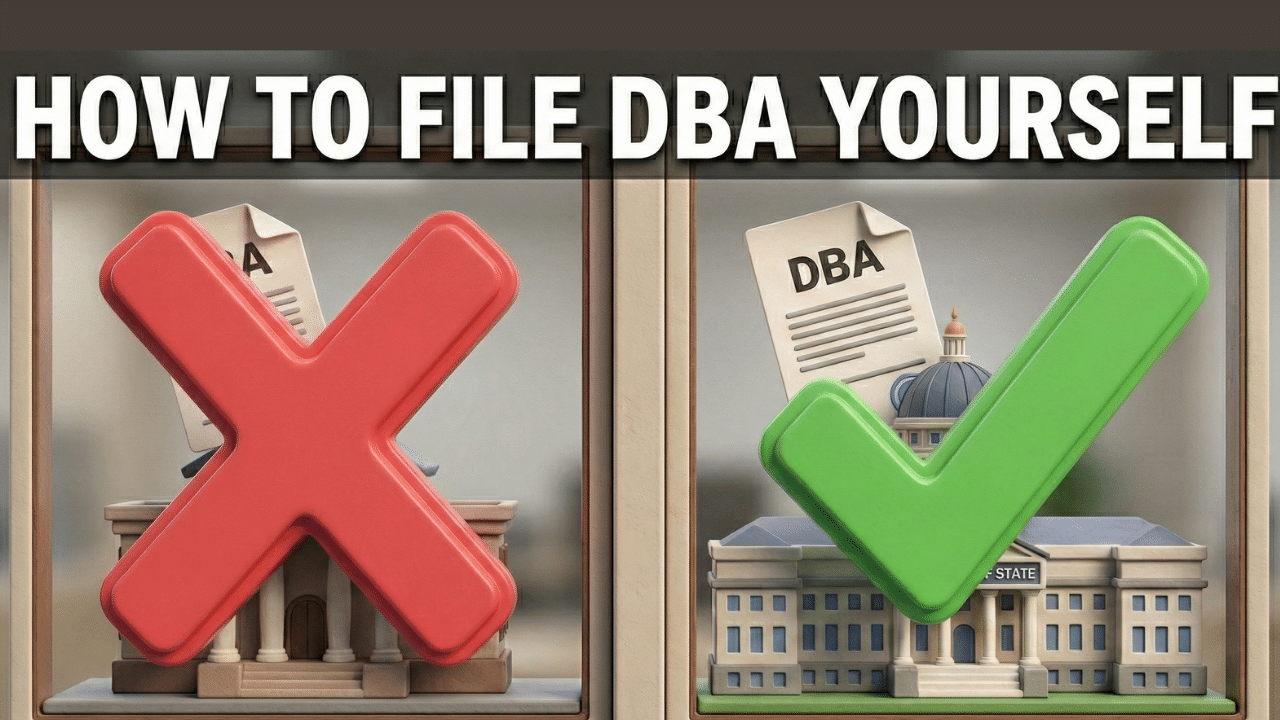
If you are operating – or would like to operate – a business under a name other than your own legal name (or your company’s legal name), you need an Assumed Name Certificate, commonly known as a DBA (“Doing Business As”).
While filing a DBA seems like a straightforward administrative task, there are two major misconceptions that often trip up Texas business owners. One can leave you legally exposed, and the other just wastes your time and money.
In my latest YouTube video (link below), I walk you through the actual form step-by-step so you can handle this filing yourself. But before you watch the walkthrough, you need to understand where to file and what a DBA actually does.
It will be brief. I promise.
The most dangerous misconception about DBAs is that they offer legal protection. In fact, they offer no protection whatsoever.
A DBA is not a business entity like an LLC or a Corporation. It does not create a corporate veil. It does not separate your personal assets from your business liabilities.
Think of a DBA as a nametag.
- If you put a nametag on a Sole Proprietorship, you are still a Sole Proprietorship. If you get sued, your personal house and savings are still at risk.
- If you put a nametag on an LLC, you still have the protection of the LLC, but the nametag itself isn’t adding any armor.
A DBA is simply a nickname that allows you to cash checks and advertise under a different name. Do not confuse a “nickname” with a “shield.”
If you walk into a County Clerk’s office to file a DBA, they will happily take your money and stamp your form. What they won’t tell you is that a county-level DBA is only effective in that specific county.
Texas has 254 counties. If you want to do business statewide, do you really want to pay 254 separate filing fees?
The Solution (covered in more depth in the video) is to file with the Secretary of State (SOS). When you file an Assumed Name Certificate with the State of Texas, it is (or, more accurately, it CAN be) effective for all counties statewide. It is more efficient, usually more cost-effective, and saves you the headache of managing multiple filings.
Why don’t the counties tell you this? Simple: They want the filing fees.
If you have your entity set up and you know you need a DBA, you don’t necessarily need to pay a lawyer to file the form for you. It is something you can do yourself if you know which boxes to check.
In the video below, I pull up the actual document and walk you through it, line by line, so you can get it filed correctly the first time.
If you are filing a DBA because you are just starting out, make sure you aren’t skipping the foundation. A DBA is just a sticker; the entity (LLC, Corp, etc.) is the structure that actually protects you.
If you need help setting up that structure properly, let’s talk.
Contact Us
Law Offices of Ryan Reiffert, PLLC
(210) 817-4388
info@ryanreiffert.com
)